Showing posts with label cheer. Show all posts

Friday, February 28, 2014

#CheerFaceFriday

Nervous about what face is the "right" face to make while performing on the mat?

Well here are some pictures of me and Lil Jess warming up our cheer faces before competing on the  UCA Nationals mat just a few weeks back! There is no doubt that these cheer faces are what got us through to Finals! 


Just remember  you should always warm up your cheer faces before you perform, you do not want to pull a muscle! And most importantly,  DO NOT be afraid of making a fool out of yourself! 


*DO NOT FORGET TO UPLOAD  PICTURES OF YOU AND YOUR TEAM  MEMBERS MAKING  FUNNY CHEER FACES AND BE SURE TO USE THE HASHTAG CHEERFACEFRIDAY! 

Thanks,
Dani
Senior CLB, Cheer Humor

Friday, June 28, 2013

Cheer360 Summer Fun: #Cheer360Flexercise Competition!

As school has ended and the summer has finally set upon us, we here at Cheer360 decided to have a summer long, friendly and fun competition. Cheer360 builds smarter, stronger and better cheerleaders. To do that, it is important that we exercise, maintain a well balanced diet, mentally prepare and most of all, have fun while doing so.

To make sure we continue to smile both on and off the competition mat, Cheer360 is having a summer long, #Cheer360Flexercise competition. So what does that exactly entail you ask? Here are the details:

1. First and foremost, while this is a competition, it is important that we have fun! Cheer360 promotes healthy lifestyles, self awareness, confidence and lifelong learning. The competition's goal is to reinforce these ideas and help the community 'find their personal greatness.'

2. So what is a #Cheer360Flexercise competition? Cheer360 asks that you tag or upload as many pictures or videos of you, your friends, family, pets or team doing your favorite flex or exercise or both! Perhaps, your favorite exercise is burpees (everyone's favorite exercise) or box jumps into a needle (see our Long Island Cheer athletes below) or tuck jumps. If that is the case, take a picture or video and send it to us!


3. How can you send us your videos and pictures? While using the #Cheer360Flexercise hashtag, you can tweet us on Twitter, tag us on Facebook or Instagram at Cheer_360 or upload a video to our YouTube page.  Remember, it is important that you use the #Cheer360Flexercise hashtag!

4. See rule 1.

5. So how do I win? Cheer360 staff and social media likes, shares, favorites, retweets etc. will determine the winners. Creativity, fun and the proper execution of the exercise are equally important. Yes, there will be multiple winners.

6. Can you submit more than one photo or video. Yes! You can submit as many as you like, but don't forget to use the #Cheer360Flexercise hashtag!

7. So what do I win? Winners will receive prizes that range from, exercise equipment, Cheer360 training sessions, workout gear and gift cards.The prizes will be posted on our website in August.  

8. Remember, all videos and photos will be posted for everyone to see. As rule number 1 states, this is meant to let people know that fitness and healthy living are not only important but fun. Good sportsmanship is important to this competition and Cheer360 has the right to disqualify any participants if their entry is inappropriate or done in poor taste.

9. Who can submit photos? Anyone can! Friends, family, Cheer360 athletes, staff, teams, pets. As long as they are following our rules, anything is possible!

10. Lastly, have fun, be creative and show us what great things you are all capable of achieving!

Continue to follow our blog and website as we will compile an album that will showcase all our #Cheer360Flexercise participants!

If you have any questions about our competition or would love to learn more about Cheer360 and our program, feel free to register at www.cheer-360.com for updates or email Coach Kristen at Kristen@cheer-360.com


Coach Mike says, "Let the #Cheer360Flexercise begin!!!"

As a Cheer360 Co-Founder, Arthur's young, energetic and ambitious career has prepared him for his exciting role as the Director of Operations and Business Development. Here he manages business operations and establishes strategic partnerships that will bring the latest equipment, guest speakers, food and nutrition and educational programming directly to the athletes, families and communities served by Cheer360. For more information visit: www.cheer-360.com

Friday, June 21, 2013

Spotlight: Cheer360 Athlete Meghan Ruggiero Receives "Find Your Greatness Scholarship"

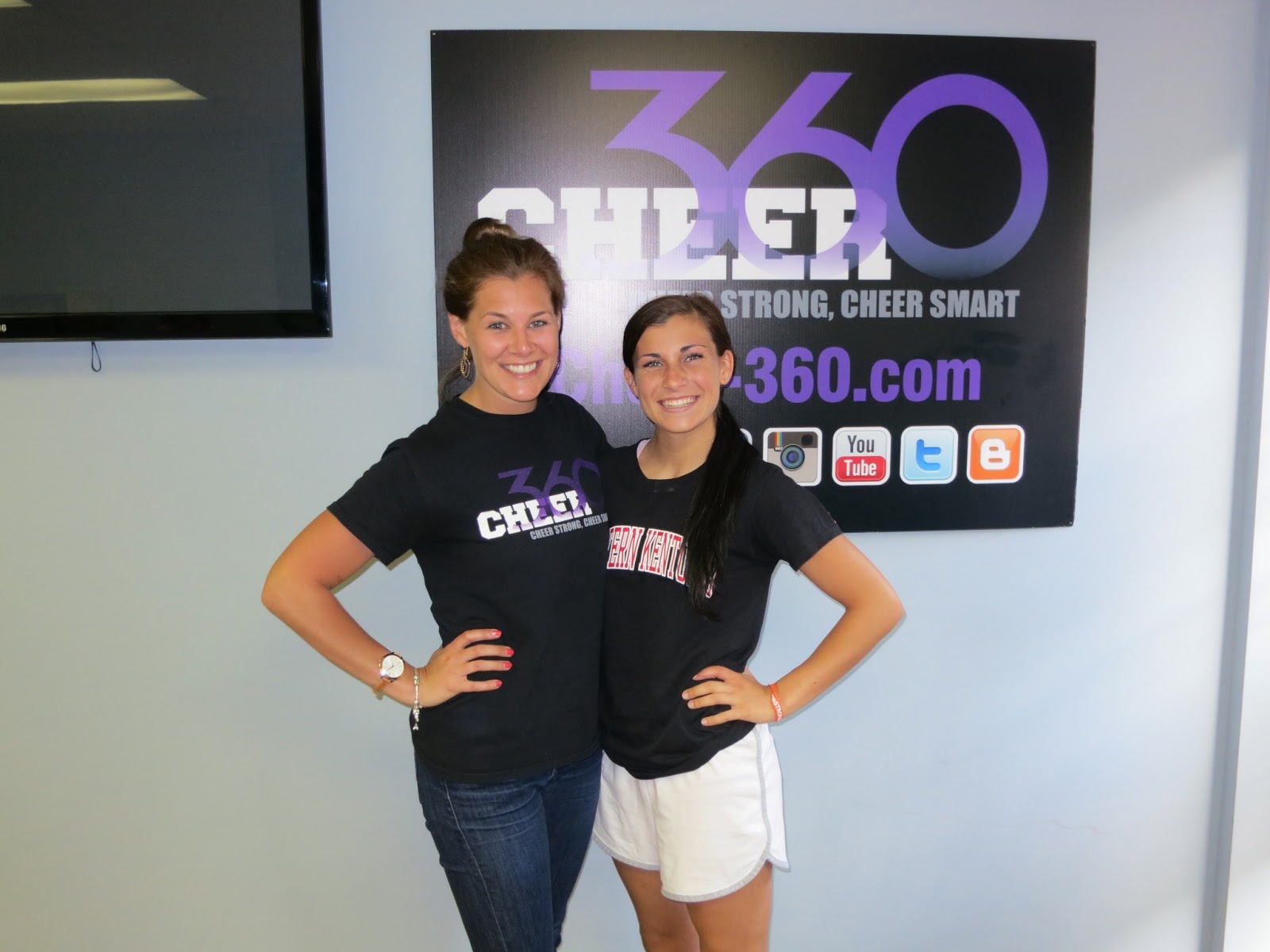
Recently, we celebrated the accomplishment of Cheer360 athlete, Meghan Ruggiero on her acceptance into Western Kentucky University and her placement on the Cheerleading squad. Cheer360 awarded Meghan with a $100, 'Find Your Greatness Scholarship.' The newly established scholarship is meant to support Cheerleaders who pursue their dreams of furthering their Cheerleading career at the Collegiate level. 

The newly established scholarship program was created to meet the financial needs of the traditionally under-served scholarship population found within the sport of Cheerleading. Scholarship money goes towards covering any incurred costs related to serving on a Collegiate Cheerleading team. 

Cheer360 was able to speak to Meghan and ask her some questions and celebrate this special accomplishment. 

Bio
Athlete Name: Meghan Ruggiero
Team and Position: Smithtown East, Flyer
College: Western Kentucky University, Class of 2018

Cheer360: Tell us a little bit about yourself and how you decided that you wanted to be a Cheerleader?

Meghan: As a young girl, I always looked up to and found inspiration from my sister, Ashley. When my sister joined cheerleading, I was able to see how it positively challenged her while at the same time, how much fun the sport was as well. In seeing this, I decided I must become a Cheerleader! 

Cheer360: What is that you like most about the sport of Cheerleading?

Meghan:  I really like the family aspect of Cheerleading, you spend so much time with your team they quickly become your family. It is really nice to have made so many memories with my team and know that should anyone need something, we are all there for each other. 

Cheer360: How has Cheer360 helped you achieve your goals and find your greatness?

Meghan: Cheer360 has made me a stronger cheerleader overall. It has given me all the skills I will need to be the best possible athlete. I only wish Cheer360 was around when I first starting cheering! 

Cheer360: What are you looking forward to most about Western Kentucky University and their Cheerleading program?

Meghan: I am looking forward to all the new challenges WKU Cheerleading will put before me. I like being challenged and I believe being part of this team will push me to my full potential and help me reach greatness!

Cheer360: Meghan, before you go, do you have any words of advice for other Cheerleaders who want to follow in your footsteps?

Meghan: I would give young Cheerleaders the advice to work hard, even when times get tough, you must stick with it and work harder. The success you achieve will all be worth it! Also, never say I can't!

Cheer360: Thank you for your time and answers. We want to wish Meghan much luck and success in her pursuits. We are confident that she will succeed and continue to make her family, friends, teammates and Cheer360 very proud.

Cheer360 is always looking to support our athletes by helping them find their own personal greatness. If you are a college bound cheerleader and wish to apply, please contact Coach Kristen (Kristen@cheer-360.com) for more details. 

Big Smiles with Meghan and Coach Kristen

Thumbs up for Success! Western Kentucky University look out! 


Wednesday, June 5, 2013

You Know You're A Cheerleader When


1.     You have more cheerleading shirts than regular clothes.


2.    You’ve said, “I can’t. I have cheerleading."


3.    You hear a song that reminds you of an old routine and instantly you start performing it.


4.    Counting to 9 seems weird to you.


5.    You can do more push-ups than most guys in your Physical Education class.


6.    You’re ready at any moment to defend cheerleading when someone says it’s not a sport.


7.    You have a pair of soffee shorts in every color.


8.    You feel the need to stunt anytime, anyplace (pool, hotel lobby, kitchen, classroom).


9.    You pray for a snow day from school but hate when you realize that means practice is canceled.


10.  You have more bows than a five year old.


Shari Tarburton is Cheer360’s Co-Founder and Director of Educational Programming.  She is a New York State Certified Health and Physical Education Teacher, a certified Personal Trainer and Mental Game Coach, and a Varsity cheerleading coach.

Monday, June 3, 2013

The Value in a Training Diary


For most athletes the hours, days and months seem to fly by when you are in season. Before you know it you are at your last game or competition and can’t really remember everything you did to get to this point. Whether the outcome of that game or competition is what you had expected or not wouldn’t it be great to look back and be able to analyze the path that got to you to that point?

One of my biggest suggestions for any athlete who is looking to improve their performance is to keep a training diary. Keeping a training diary is probably one of the most useful, yet overlooked secrets in sport! This can be done in so many ways, you just need to find which one works best for you. Get a notebook and keep it in your sport bag to write in immediately following a practice or competition, create a virtual notebook on your computer to write in when you get home, or download a training diary app from your smart phone to have wherever you go!

Coach Kristen has developed a training diary template that can be found and printed out by clicking HERE! Take the time after each practice game or competition to answer these questions and add anything else you feel is important. Make sure to look back periodically and evaluate your training either alone or share your diary with your coach and ask for his or her suggestions. Because remember…you cant figure out where you are going without knowing where you have been first!


Kristen Perri is Cheer360’s Co-Founder and Director of Mental Fitness.  She holds a masters degree in Sport Psychology, is a certified Mental Game Coach, Sport Hypnotist and Personal Trainer.  With over 8 years of cheer coaching experience, Kristen has coached all skill levels including middle school and junior varsity. Currently, Kristen is the Head Varsity Coach of a major Long Island Cheerleading Program. 

Thursday, May 9, 2013

The F.I.T.T.E: Guidelines for Exercise


Frequency Intensity Time Type and Enjoyment (F.I.T.T.E) are the five guidelines that every athlete should keep in mind when personalizing a training program.

Frequency is the number of training sessions in a given time frame. The number of training sessions can be broken down by year, month, or week (long term, short term, and immediate results) depending on the athlete’s goals. Training frequently for shorter periods of time is how an athlete would try to obtain immediate or faster results in order to reach short and long term goals.

Intensity is the level of demand that a given activity places on the body. Knowing how much intensity to use for each program plays a huge role in the program’s success. For example, cheerleader A’s short term goals are to improve her jumps and tumbling within a six-week training program; Cheerleader B’s long term goals are the same; however, she wants to accomplish them within a six-month period. The six-week workout program used by cheerleader A requires high levels of intensity, more frequently, to produce maximum results. The longer six-month workout program used by cheerleader B requires the same high level of intensity, less frequently, enabling athletes to achieve goals more gradually with a lower risk of injury.

Time refers to the length of time an athlete is engaged in a physical activity. Workouts for strength athletes such as cheerleaders should average between 30 and 90 minutes. The shorter 30-45 minute time frame is recommended for in-season training programs. The longer 60-90 minute time frame is recommended for pre and post-season training programs.

The second T in the guidelines is Type. Type is the mode of physical activity that an individual is engaged in. This can be any activity that raises your heart rate above its normal resting level (RHR). “What type of exercise is the best?” This is the number one question I am asked as fitness professional.  My answer is and always will be the same: “Do whatever you enjoy doing the most, the most often, unless you are preparing for a specific sport or sporting event.”

The final and most important principle of the guidelines is Enjoyment. If you don’t enjoy what you are doing, then it’s time to change it up. Training programs are hard; they are designed to be that way. Programs are made to overload your body with stress to promote new growth and abilities, both physically and mentally. The results are what make the stresses worth it. “Endure the obstacles on the path, embrace the journey, earn the results, and enjoy when you reach each destination along the way.” 


Kent Tarburton is Cheer360’s Co-Founder and Director of Fitness. He holds Personal Training certifications through the National Academy of Sports Medicine (NASM), the American Aerobic Association International (AAAI), the International Sports Medicine Association (ISMA), and is a certified Mental Game Coach.

Friday, May 3, 2013

Fun Friday: Putting Cheer360 Core Values to Use!

For their entire lives, the owners of Cheer360 have used their collective set of core values as their moral compass for their everyday decision making. These core values are what make each of us ourselves, and Cheer360 the premier strength, nutrition and mental coaching program for cheerleaders. For those of you who are unfamiliar with Cheer360 core values, I am going to utilize this as an opportunity to showcase through our actions, how we roll up our sleeves, influence and empower our athletes, and lead by example.

Excellence: in all we do directs our Cheer360 team to develop a sustained passion for continuous improvement and innovation that will propel Cheer360 athletes into a long term, upward spiral of accomplishment and performance.
  • Cheer360 has not only worked hard to achieve success, but we hold ourselves accountable in doing so. It is often said that hard work and achieving excellence in all that we do, will not go unnoticed. This was the case this past week as one of the top division I NCAA Cheer programs, The University of Central Florida, recognized our work by "liking" our motivational images and commenting back on our Cheer360 Instagram as seen here. This was a big boost of motivation to not only our team but our athletes as well. 
Persistence: We require that the Cheer360 team possesses the inner drive necessary to position oneself to overachieve daily. The majority of successes happen just after overcoming the most difficult. This is where the personal development comes in. Remember, just keep going!
  • Cheer360 helps our athletes map out nutritional, mental and physical plans. This balanced approach will lead to an overall improved healthy lifestyle that will last a lifetime. Who knew that boxes were not just meant to be jumped on? 
Respect and Humility: We value the strengths, experiences and perspectives of others, and we recognize our own limitations. Cheer360 places value in those around us as they are not only a source, but a beneficiary of our success. 
  • One of our smallest, yet hardest working athletes, Crista embodies the famous Mark Twain quote, "It is not the size of the dog in the fight, it is the size of the fight in the dog." Crista's hard work, has been an inspiration to us all, as seen by her quick rise to Instagram fame, notice the comments of support! 
Team: We value and care about each other, operate with a generosity of spirit, and have fun in the process of working together. To maximize our collective impact, we inspire, challenge and support each other to be our best and sustain our efforts. 
  • Cheer360 has the benefit of seeing our hard work blossom into greatness right before our eyes. To ensure our success continues, we as a team work really hard to challenge one another to put forth creative, challenging and fun ideas. This is most evident in a recent team push up session!
Community:  We are committed to the cultivation of positive relationships between, and common experiences among, athletes, parents and staff. We instill a strong sense of self recognition and purpose with our athletes. These skills empower our athletes to serve as leaders in their communities. 
  • Cheer360 has begun establishing the framework for a Cheerleader mentoring program. This mentoring program model will be implemented in communities that have youth cheer teams/leagues. Cheer360 will mentor current Cheer360 athletes to become coaches and mentors themselves for youth cheer programs. This program will develop future leaders and be a tremendous investment in the communities overall future.
I hope you enjoyed seeing how we practice what we preach. With being open for just under a month, Cheer360 has been to able to inspire and put smiles on the faces of many. We are thrilled and excited about all the support we have received and look forward to the bright future ahead. Remember, it is more than just cheerleading for us, it is a balanced healthy lifestyle that will last a lifetime. 

As a Cheer360 Co-Founder, Arthur's young, energetic and ambitious career has prepared him for his exciting role as the Director of Operations and Business Development. Here he manages business operations and establishes strategic partnerships that will bring the latest equipment, guest speakers, food and nutrition and educational programming directly to the athletes, families and communities served by Cheer360. For more information visit: www.cheer-360.com

Wednesday, May 1, 2013

Tips for Understanding Your Coach


High school cheerleading can be beneficial beyond just keeping you in shape and offering you something to do after school.  Many life skills are taught through athletics, including dedication, commitment, teamwork, leadership, goal setting, responsibility, and communication.  Having a positive role model, such as your coach, helps aid in building these valuable traits that carry with you your entire life.

Having a positive relationship and a mutual respect with your coach can make any season successful.  The most important thing a coach can do is give constructive feedback.  Many athletes look for their coach’s expertise to help improve their performance.  A good coach can help psych a team up before a game or competition and can help a team handle both successes and failures throughout a season.

Relationships with your coach, for many athletes, are different than the relationships you may have with your parents or your teachers.  A coach tends to be a partner in your sport, helping you and your teammates obtain a common goal.  Understanding this can help you feel more comfortable with your coach and respect their guidance and knowledge.

Tip 1: Trust your coach.  Having faith that your coach has the best interest of your team at heart is extremely important.  Your coach is the one setting the schedule, and if you want to become a better athlete, you need to respect your coach’s decisions.  Sometimes athletes might resent their coaches for pushing them and motivating them to become better.  Try to understand that in the long run, the hard work will pay off.

Tip 2: Make sure that you are contributing an honest effort.  Come to every practice, game, and/or competition ready to give your best.  To help build respect with your coach, you need to do more than just go through the motions.  Even if you may not agree with your coach’s opinion or decision, push yourself to show your coach and your teammates that you trust them.

Tip 3: Take the initiative to work on your skills without being told to do so.  Whether you are a captain or not, make the first move when you walk into practice.  Get your team up and moving before your coach asks you to do so.  This shows your coach that you are invested and are ready to start whatever they have planned for the day.


Shari Tarburton is Cheer360’s Co-Founder and Director of Educational Programming.  She is a New York State Certified Health and Physical Education Teacher, a certified Personal Trainer and Mental Game Coach, and a Varsity cheerleading coach.

Thursday, April 25, 2013

Kettlebells with cheerleaders?


Kettlebells (weights that resemble cannon balls with a handle) were developed by Russian strongmen back in the 1700’s. These athletes used kettlebell exercises to increase strength, endurance, balance, and flexibility.

The American Council on Exercise (ACE) conducted a study in 2010 to see how demanding kettlebell exercises were on an athletes cardiovascular system. The study consisted of 10 volunteers (all experienced kettlebell users) ranging in ages from 29 to 46 years.

The first test given to the athletes was a five-minute kettlebell VO2 max snatch test to establish a baseline for their overall kettlebell fitness. Each athlete’s heart rate and oxygen consumption were monitored carefully during the test. Once the baseline was determined for the group, ACE put the athlete’s through a 20-minute kettlebell circuit while monitoring heart rates at 60-second intervals.

The average aerobic calorie burn for the 20-minute workout was 272 calories. Using a formula to estimate oxygen consumption, ACE was able to determine the athlete’s were burning 13.6 calories a minute aerobically. ACE also found that the athletes were burning an additional 6.6 calories per minute anaerobically. Overall, the athletes were burning 20.2 calories a minute, an amazing 1,212 calories an hour!

Kettlebell training can be used in every aspect of a cheerleader’s competitive lifestyle. Our motto at Cheer360 is injury prevention and healthy lifestyles. Cheer360 implements kettlebell training with all of our athletes so that each individual is benefiting from the most physically and mentally demanding exercise ever created.  This in turn produces cheerleaders that have the muscular endurance and strength needed to compete at their highest physical and mental capability.


Kent Tarburton is Cheer360’s Co-Founder and Director of Fitness. He holds Personal Training certifications through the National Academy of Sports Medicine (NASM), the American Aerobic Association International (AAAI), the International Sports Medicine Association (ISMA), and is a certified Mental Game Coach.

Wednesday, April 24, 2013

Behind the judges table: 3 tips to get you ready for tryouts

Cheerleading tryouts for some athletes can be an intimidating and nerve-wracking experience.  Many cheerleaders tend to focus their energy on major skills that coaches often look for (stunts and tumbling) but forget about the basic components that can improve your score tremendously. 

Tip 1: Show up to tryouts with a competitive mindset.  Showing a tremendous amount of spirit, no matter what you’re doing, can set you apart from your competitors.  This begins by arriving to tryouts every day at least ten minutes before the practice is set to begin.  This will allow you time to put your stuff away, put your sneakers on, and begin to mentally prepare for what the day is about to bring.  “Looking the part” is extremely important as well.  Make sure you are wearing the designated clothing required for tryouts, your hair is pulled back neatly with a bow, you have removed all jewelry from your body, and your nails are cut short.  All of this shows the coaches and the judges that you are invested in becoming a part of their team and ready to meet any challenges that await you.

Tip 2: Work on improving basic technique and skill level during your off-season.  As a coach at the high school level, I expect all cheerleaders to show up to try-outs with perfect jumps.  This does not mean that you have to have the highest jumps, but what it does imply is that you should have perfect technique in your approach to your jumps and throughout the skill.  As a cheerleader, the only way to improve on this fundamental skill is by practicing them every day on your own!  Setting aside at least 30 minutes a day to work on stretching and your jumps in front of a mirror can help you obtain the flawless jumps that you have been working towards, impressing everyone that is watching you.

Tip 3: Take care of your body when you are away from the mat.  Make sure you’re eating a well-balanced diet to ensure you are gaining proper nutrition.  This will allow you to have enough energy to get through anything that tryouts may bring.  Getting enough rest each night is equally important because it helps your mind and body recover from all the stressors that tryouts brings, helping you to prepare for the upcoming days.  Lastly, make sure that your aerobic and anaerobic endurance is at its peak performance.  This comes from implementing an aerobic and anaerobic training program at least 6 weeks prior to tryouts.


Shari Tarburton is Cheer360’s Co-Founder and Director of Educational Programming.  She is a New York State Certified Health and Physical Education Teacher, a certified Personal Trainer and Mental Game Coach, and a Varsity cheerleading coach.

Thursday, April 11, 2013

Do we really need to warm-up and cool-down?


Warm-up and cool-down are the most overlooked aspects of an athlete’s training program. The number one excuse athlete’s give is, “I don’t have time.” Cheer360 is here to tell you that you need to start making time! 

Your warm-up and cool-down are essential for elevating performance output, heart rate, injury prevention, and overall health.  A warm-up should consist of a low-to-moderate intensity exercise for 10 minutes. For cheerleaders, the exercises used during a warm-up should mimic movements that will be done during practice, a game, and/or a competition. For example, if you are going to be working on toe touches, pikes, and herkies, then warm-up with 15-20 prisoner squats to increase blood flow to the quadriceps, gluteals, and hamstrings. This 10-minute bout will elevate heart rate, respiratory rate, increase tissue temperature, and increase psychological preparation for the duration of the cheerleading practice, game, or competition.

Cooling down is just as important as warming up because it gives the body a chance to slow the heart rate, respiratory rate, decrease tissue temperature, and return the body to a state of rest. Cool-down exercises need to consist of the same exercises executed during the warm-up.  These exercises should be done in a slow to moderate tempo in order to decrease heart rate and breathing.   Static stretching and foam rolling exercises should also be incorporated into the cool-down to help relax muscles and allow them to return to their original resting length.

 Visit Cheer360 today at www.cheer-360.com  to learn more sport specific warm-up and cool-down exercises for your cheerleading team.

Monday, April 8, 2013

Progress NOT Perfection


“Perfect” is an unrealistic word used commonly by athletes when explaining what they want.  The word “Perfect” is as much of a curse word in sports as “I Can’t!”  Stop searching for perfection and start moving towards personal progress. 

Close your eyes and imagine this scenario, I’m sure it has happened to at least a few of you out there reading. 

You have been working all season on the stunts in your routine but every competition this season you have gotten scared and the stunt has fallen.  The last competition of the season is approaching in 2 weeks and all you can think of and say to yourself is “I have to hit all my stunts perfectly!” The pressure is on to make your last performance perfect so you can prove to yourself, your team, your coach and the judges that you are an outstanding athlete.  You feel that if you do not perform perfectly at this last competition you will be a failure. 

Searching for this illusive perfect performance is only setting you up for a let down. When we will only accept perfection anything else is going to be unacceptable and disappointing.  Searching for the perfect performance is the one thing the athlete should not be focusing on. 

Now you must be wondering to yourself “well, what should I be focusing on if it’s not to be perfect?”  That answer is simple, PROGRESS! Going back to the scenario above it would be best to treat this last competition as a chance to improve from your past performances.  Always focus on having a better performance from your last, this is called progress.  When you open up your mindset from being perfect to being better you allow for a more accurate description of how you performed.  When you focus solely on being perfect you can only judge yourself as either perfect or imperfect.  But when you search for progress and strive to become better than before you open up your outcomes and will be a better athlete because of it. 

Progress not Perfection is a true champions mindset!

For more information on Mental Game Coaching visit www.cheer-360.com


Thursday, April 4, 2013

What is foam rolling and why is it important to cheerleaders?

Foam rolling, also known as self-myofascial release, is a stretching technique that focuses on the connections the brain has with all the muscle groups in an athlete’s body.

When athletes exercise, their muscles become damaged. This damage is actually adhesions, commonly referred to as “knots,” in the fibrous materials that surround individual muscles. The adhesions cause what was once a long, straight muscle fiber to become short and bundled. These adhesions cause the pain and soreness in the days following an athlete’s exercise.

Neuromuscular efficiency is the ability of the neuromuscular system to allow agonists, antagonist, and stabilizer muscles to work synergistically to produce, reduce, and dynamically stabilize the entire kinetic chain in all three planes of motion. So what does this mean for cheerleaders?  In order for a cheerleader to increase her neuromuscular efficiency, foam rolling stretching should be incorporated into an athlete’s daily stretching regimen.

Foam rolling helps cheerleaders maintain optimal neuromuscular efficiency by applying gentle force to an adhesion or “knot,” therefore bringing the bundled muscle fiber back into a straighter alignment. The gentle massage produced by the foam roller causes receptors within the muscles to relax, releasing the tension of the underlying musculature. This helps restore the body back to its optimal level of function by resetting the receptors within the muscles, causing them to unbundle and return to their original length.

If a cheerleader lacks neuromuscular efficiency, her brain, cannot properly tell her muscles to contract, relax, and balance when they need to, resulting in possible injury.  When a cheerleader performs a tumbling pass, she needs to create a hard muscle contraction to propel her body off of the floor; muscles then need to be able to decelerate the athlete’s body for a safe, soft landing; and finally the muscles need to be able to stabilize the body so the cheerleader does not lose her balance and fall to the floor once she has landed. By not using a foam roller, the same tumbling pass may result in improper take off or landing (usually resulting in a fall), possibly causing a sprain, fracture, or damage to a ligament, major joint, or bone.

Visit CHEER360 to learn the proper technique to foam rolling so you can start perfecting your overall performance today!


Our Website:www.Cheer-360.com

Wednesday, April 3, 2013

When Cheerleading Ends


High school cheerleading is more than just promoting school spirit at football and basketball games and competing locally, regionally, and nationally from November through February.  If you sit in on a three hour practice, you will find that these athletes should be gaining something bigger.  Like all sports, cheerleading teaches skills that transcend to all aspects of a person’s life and future.

Teaching young athletes how to maintain an optimum level of wellness is just as important as teaching them how to jump, stunt, and tumble.  One of CHEER360’s goals is to promote healthy lifestyles not only during their cheerleading careers, but also throughout their entire lives.  Learning how to build and maintain muscular strength, cardiovascular endurance, and flexibility will reduce the likelihood of injuries now, as competitive cheerleaders, as well as in their futures.  The fitness related benefits that can be taught to teenagers are ones that can be carried throughout their college careers, adulthood and beyond. 

Having a regular fitness regimen in place improves one’s overall sense of well-being including body posture, endurance for daily activities, an increased self-esteem, and a decreased likelihood of developing lifestyle diseases. But, as much as we don’t want to think about this, at some point, a cheerleader’s career will come to an end.  Often times this leaves a previously active person struggling with ways to keep fit.  So why not start teaching these habits now to our cheerleaders in order to promote long, healthy, and successful lifestyles?  After all, other sports have been doing this for years!  

Tuesday, April 2, 2013

Are You a Cheater?


The word “cheat” usually conjures up a lot of negative thoughts.  Whether it is cheating on an assignment or in a relationship, it is not a good thing.  But when it comes to being on a diet, the concept of having a “cheat” is one that people start out thinking “what a great idea!”

People wait for their allowable “cheat” times with mouths watering.  They think about all the delicious treats they will indulge themselves in, believing these indulgences at specific times will keep them on a healthy track for their “diet days.”Incorporating “cheating” into a diet plan is very popular in a lot of current diet trends.  The Paleo diet encourages cheating on the weekends or two days a week, while focusing on eating foods our earliest ancestors would eat (animal protein, fruits, vegetables, no gluten and no dairy) the rest of the week.  The new“fast diet” which encourages “intermittent fasting” says you can eat whatever you want five days a week, but can only have 500 calories on two other days.  The idea in both of these examples are the same, by giving people the right to eat “whatever” at certain times, they are more apt to stick to their “diet plan” as opposed to diets that have you watching what you eat everyday.

The problem is, cheating is a negative thing when dieting.  It usually begets more cheating because when you restrict yourself, you want things that you can’t have even more.  It is a big reason why people have difficulty staying on a diet and weight loss and gain can go back and forth.  Not to mention it hurts your metabolism by slowing it down, the last thing you want when you are trying to maintain a healthy weight.  The schedule of your life should not revolve around cheat days.  What if it is Wednesday and you want to eat a dessert when you are out with your friends after a game?  You have the right to eat that dessert even though it was not your “cheat” day.

Eating should be an enjoyable part of life that helps make you more equipped to handle your daily life and the things it can throw at you.  When the way you eat becomes intuitive, you are no longer restricted to a crazy diet with rules.  You will find yourself tuning into your hunger signals and being able to appease them without being unhealthy.

If some of this sounds familiar and you want to know more about intuitive eating, feel free to email me at shelbi@cheer360.com or visit our website at http://www.cheer-360.com.